Big Bubbles

Big Bubbles, No Troubles

Nouriel RoubiniNouriel Roubini AKA Dr. Doom did it again. His tweet released on August 23 where he compares gold values to Y2K tech bubble has quickly sparkled reactions among analysts and other pundits.

Among them, the strongest critic comes (no suprise!) from Adrian Ash of  BullionVault, the world’s No.1 gold ownership and trading service:

[Roubini says that] Gold is a dumb thing to buy. Because it’s a bubble, plain and simple and always.

“Since gold has no intrinsic value,” says Dr.Doom, “there are significant risks of a downward correction.

Oh sorry – that was him way back in December 2009, not here in August 2011. Gold Prices have very nearly doubled since then, despite having no value to New York University economists. But no matter. It’s what happens next that counts.

Uh-oh! Then Ash puts in evidence what I think is really is a macroscopic error by Roubini. In his tweet he had linked a chart comparing gold in tha last ten years vs. Nasdaq in the 90s, asserting that there is nothing new under the sun: gold is in a big bubble just like tech stocks 10 years ago.

Gold vs Nasdaq - Roubini

What Ash notes is quite obviuos:

This chart is more than simply “time-adjusted” (as he claims) in mapping the “gold bubble” onto the “Nasdaq bubble”.

Note, for instance, that its vertical axes show nominal prices (Dollars per ounce for gold, index value for the tech-stock Nasdaq). That overplays gold’s relative gains, now running at 6-fold since the chart’s starting point. The Nasdaq, at its top of only a few months earlier, you’ll recall, towered more than 10 times higher from a decade before.

That said, in my very humble opinion, gold is due for a correction. It would be a non-event to see a sudden drop in gold. This would actually be a healthy development for markets by shaking out the short-term speculators while the long-term story remains on solid ground.

Frank Holmes, contributor of seekingalpha, is on the same path. He has written a very good article on The Neverending Story of a Gold Bubble, indicating many fundamental reasons that could pop the “gold bubble” talk without using complicated charts or angry words: if you are interested in this subject you should definitely take a look at it.

Original articles:

Adrian Ash – If Gold Were the Nasdaq
Frank Holmes – The Neverendig Story of a ‘Gold Bubble’

Bye Bye Post Office

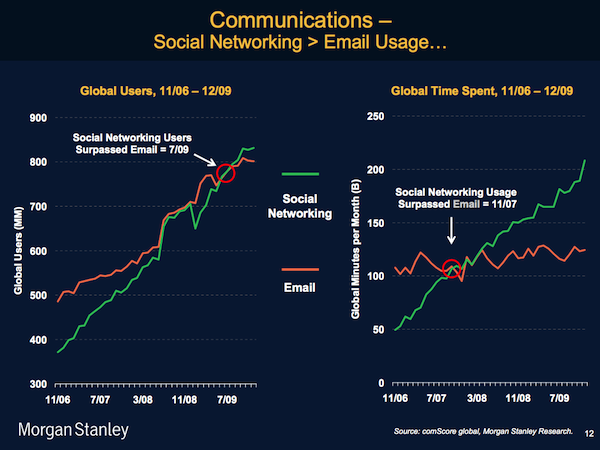
Remember one of the most retweeted chart of 2010? It was ripped off the Morgan Stanley’s Internet Trends presentation, and showed how social networking messaging systems have already surpassed email usage:

Chart from MS Internet Trends 2010 presentation

Whether it’s Twitter, Facebook, or some other social networking service, I believe the lighter weight communication paradigm (say less, reach more) is superior to email for many things. Nonetheless, email’s usage is still growing and IMHO is more suitable for long-form serious private conversations.

You may think that this trend is affecting only the way we send and receive messages on the web. What about the old, tangible, bunch of papers we find in our real mailbox? The Economist has a nice article depicting the volume of mail handled by the US Postal Office:

USPS - Letters no more

As ever more Americans go online instead of sending paper, the volume of mail has been plummeting […] Delivery costs are simultaneously going up. As a result, the post has lost $20 billion in the last four years and expects to lose another $8 billion this fiscal year […] As Christmas cards have gone online (and “green”), so have bills. In 2000, 5% of Americans paid utilities online. Last year 55% did.

USPS is planning to close post offices; up to 3,653, out of about 32,000. This month it announced plans to lay off another 120,000 workers by 2015, having already bidden adieu to some 110,000 over the past four years (for a total of about 560,000 now). It also wants to fiddle with its workers’ pensions and health care.

The post will have to stop delivering mail on Saturdays. Then perhaps on other days too.

USPS was born “to bind the Nation together”. Now it looks like there is a substitute: Internet.

E-cart

June 2011: Most popular retail sites

comScore Logo

Amazon, eBay and Alibaba See Largest Global Audiences
In June 2011, Amazon Sites had the largest global audience among the the retail and auction sites analyzed, with more than 282 million visitors, representing 20.4 percent of the worldwide audience age 15 and older accessing the Internet from a home or work location. eBay was not far behind with 223.5 million visitors (16.2 percent reach), followed by China’s Alibaba.com Corporation, which includes sites such as Taobao, Alibaba.com and Alipay, with 156.8 million visitors (11.3 percent reach). Apple.com Worldwide Sites saw its global audience eclipse 134 million visitors, representing nearly 10 percent of all Internet users.

Select Retail and Auction Sites Ranked by Unique Visitors (000); June 2011; Total Worldwide Audience, Visitors Age 15+ – Home/Work Locations
Source: comScore Media Metrix
Total Unique Visitors (000) % Reach
Total Internet : Total Audience 1,383,098 100.0%
Amazon Sites 282,233 20.4%
eBay 223,520 16.2%
Alibaba.com Corporation 156,780 11.3%
Apple.com Worldwide Sites 134,296 9.7%
Rakuten Inc 57,785 4.2%
Wal-Mart 44,650 3.2%
Hewlett Packard 38,491 2.8%
MercadoLibre 33,481 2.4%
Otto Gruppe 31,779 2.3%
Groupe PPR 31,686 2.3%

Geographical Visitation Analysis for Retail and Auction Sites
Analysis of the geographic composition of visitors to these select retail and auction sites revealed a mix of both globally distributed audiences and more regionally concentrated audiences. Amazon Sites and Apple.com Worldwide Sites showed more globally distributed audiences compared to most other brands in the study.

On the other hand, China’s Alibaba.com Corporation (85.7 percent) and Japan’s Rakuten, Inc. (72.7 percent) reach sourced the vast majority of their traffic from the Asia Pacific region.

Regional Audience Composition Analysis of Select Retail and Auction Sites; June 2011; Total Worldwide Audience, Visitors Age 15+ – Home/Work Locations
Source: comScore Media Metrix
Percent Composition of Unique Visitors
North America Europe Asia Pacific Middle East – Africa Latin America
Total Internet 14.9% 26.7% 41.1% 8.7% 8.6%
Amazon Sites 35.4% 31.8% 24.1% 4.5% 4.2%
eBay 34.6% 46.9% 11.7% 4.0% 2.8%
Alibaba.com Corporation 4.5% 5.3% 85.7% 2.5% 1.9%
Apple.com Worldwide Sites 32.0% 29.6% 24.9% 8.0% 5.6%
Rakuten Inc 5.3% 19.8% 72.7% 1.5% 0.7%
Wal-Mart 83.4% 8.9% 0.7% 0.5% 6.4%
Hewlett Packard 45.1% 26.4% 14.3% 6.7% 7.5%
MercadoLibre 1.7% 4.5% 0.4% 0.2% 93.3%
Otto Gruppe 4.3% 92.3% 1.0% 2.1% 0.2%
Groupe PPR 16.1% 74.4% 2.2% 4.7% 2.6%

Source and original article: comScore Press Release

Googlerola

Googlerola: my 2 cents

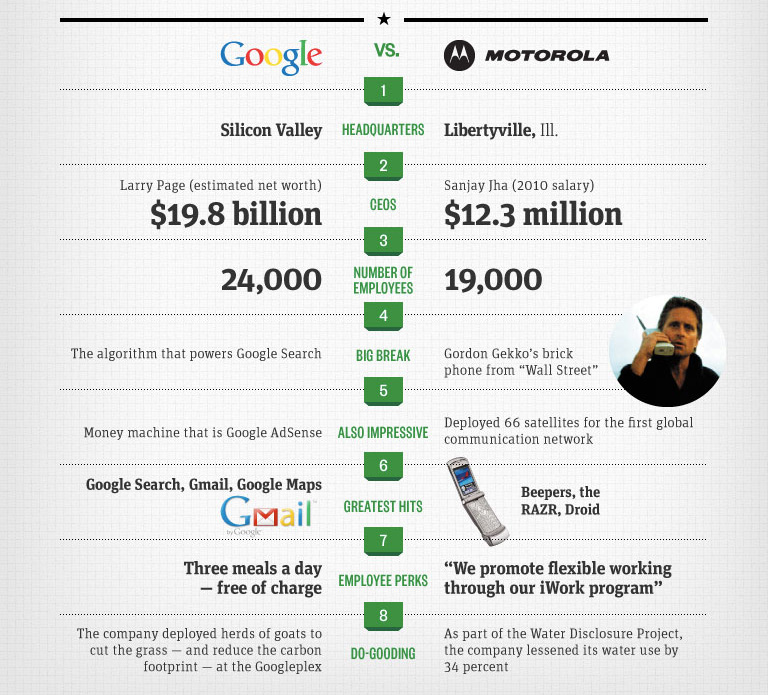
In these last days, I have tried to figure out what the outcomes of the Googlerola affair could be. There are at least four aspects to be considered:

  1. The size: 12.5B$ is A LOT of money (Motorola’s capitalization was around 7B$ when the deal came to the public);
  2. The timing: the announcement was made just in the middle of the patent war involving Google, Apple and Microsoft. Although it is difficult to imagine that such a deal has been settled in a few weeks, Page’s announcement seems to be a real timebomb;
  3. The number of individuals involved: Google is a 30,000-people company; Motorola has 19,000 employees. The simple sum gives 50,000: a really huge number. Moreover, corporate culture is fundamental in the Google development process: without massive layoffs, Google will have 40% of its employees not respecting the Mountain View standards;
  4. The role of Google in the Android Open Handset Alliance: now the hardware manifacturers have a new player to deal with.

There are already tons of different opinions on the still-to-be-approved acquisition, including ferocious critics (read Henry Blodget foreseeing a “colossal disaster”).

I decided to stick to what Steven Levy says about it. Despite his closeness to Google (Did you read “In the Plex“? You should!), the decision to buy Motorola seems to have caught Levy by surprise.

Just a couple of hours after the Larry Page’s announcement, Levy had a quite long conversation with Business Insider. There is the link to that article at the bottom of this post, but I’d like to highlight a few words from Levy:

On price:

I wouldn’t have predicted that Google would have bought Motorola but it’s not surprising because Google likes to take big bets and make big leaps.

On timing:

Certainly it’s characteristic of Larry. If he has a situation to deal with, he’ll come up with the biggest possible response because big responses and big risks is part of his makeup.

On people:

Why wouldn’t Google want to make the workforce of its new company reflect its own values which would mean getting rid of some people and bringing on other people. Larry Page vets every single employee hired at Google, do you think he’s going to take on 19,000 employees and not care about how they perform or how well they meet his standards?

On Open Handset Alliance:

Google’s invested in the Android system and it has to make sure its partners feel secure in adopting that system. I don’t know if it’s total indemnification, or if it’s just help. To me, the one thing that makes this thing go down palatably to places like Samsung and HTC, is that they’re going to benefit by Google having this patent portfolio, this protection.

Read the full article on BusinessInsider.

MMQ6UHNZYGT4

Google Analytics

Web Analytics 2.0

Web Analytics 2.0 coverI follow Avinash Kaushik both on Twitter and on his blog (Occam’s Razor). I am more on the marketing side but web analytics is critical for me, so I decided to give Avinash’s last book – Web Analytics 2.0 – a try.

WOW!

I have found myself reading the entire book in a few hours. Since I finished, I have gone back and highlighted, bookmarked and re-read the book a few times.

Avinash, with his engaging prose, teaches you to act on data instead of just presenting pretty reports: It’s the outcomes, baby!

Most SEM and Analytic books are for gurus or sucks because are too basic. In my opinion, Web Analytics 2.0 is perfect if you are at an intermediate/advanced level.
Moreover, the author donates all the proceeds of this book to two charities (The Smile Train and The Ekal Vidyalaya Foundation), so buying this book is good for you and for many others.

In times of downrating, I give my personal quadruple-A to this book.

Read more reviews and buy Web Analytics 2.0 on amazon.com
BECRWE8KN6KU