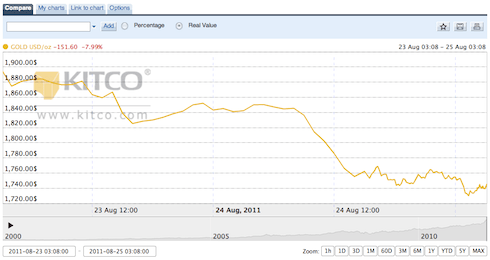
What did I say about a “sudden drop in gold”? Is -8% enough?
Update: Aug. 25, 2011
What did I say about a “sudden drop in gold”? Is -8% enough?
Update: Aug. 25, 2011
What did I say about a “sudden drop in gold”? Is -8% enough?

 Nouriel Roubini AKA Dr. Doom did it again. His tweet released on August 23 where he compares gold values to Y2K tech bubble has quickly sparkled reactions among analysts and other pundits.
Among them, the strongest critic comes (no suprise!) from Adrian Ash of BullionVault, the world’s No.1 gold ownership and trading service:
[Roubini says that] Gold is a dumb thing to buy. Because it’s a bubble, plain and simple and always.
“Since gold has no intrinsic value,” says Dr.Doom, “there are significant risks of a downward correction.
Oh sorry – that was him way back in December 2009, not here in August 2011. Gold Prices have very nearly doubled since then, despite having no value to New York University economists. But no matter. It’s what happens next that counts.
Uh-oh! Then Ash puts in evidence what I think is really is a macroscopic error by Roubini. In his tweet he had linked a chart comparing gold in tha last ten years vs. Nasdaq in the 90s, asserting that there is nothing new under the sun: gold is in a big bubble just like tech stocks 10 years ago.

What Ash notes is quite obviuos:
This chart is more than simply “time-adjusted” (as he claims) in mapping the “gold bubble” onto the “Nasdaq bubble”.
Note, for instance, that its vertical axes show nominal prices (Dollars per ounce for gold, index value for the tech-stock Nasdaq). That overplays gold’s relative gains, now running at 6-fold since the chart’s starting point. The Nasdaq, at its top of only a few months earlier, you’ll recall, towered more than 10 times higher from a decade before.
That said, in my very humble opinion, gold is due for a correction. It would be a non-event to see a sudden drop in gold. This would actually be a healthy development for markets by shaking out the short-term speculators while the long-term story remains on solid ground.
Frank Holmes, contributor of seekingalpha, is on the same path. He has written a very good article on The Neverending Story of a Gold Bubble, indicating many fundamental reasons that could pop the “gold bubble” talk without using complicated charts or angry words: if you are interested in this subject you should definitely take a look at it.
Original articles:
Adrian Ash – If Gold Were the Nasdaq
Frank Holmes – The Neverendig Story of a ‘Gold Bubble’


Amazon, eBay and Alibaba See Largest Global Audiences
In June 2011, Amazon Sites had the largest global audience among the the retail and auction sites analyzed, with more than 282 million visitors, representing 20.4 percent of the worldwide audience age 15 and older accessing the Internet from a home or work location. eBay was not far behind with 223.5 million visitors (16.2 percent reach), followed by China’s Alibaba.com Corporation, which includes sites such as Taobao, Alibaba.com and Alipay, with 156.8 million visitors (11.3 percent reach). Apple.com Worldwide Sites saw its global audience eclipse 134 million visitors, representing nearly 10 percent of all Internet users.
| Select Retail and Auction Sites Ranked by Unique Visitors (000); June 2011; Total Worldwide Audience, Visitors Age 15+ – Home/Work Locations Source: comScore Media Metrix |
||
| Total Unique Visitors (000) | % Reach | |
| Total Internet : Total Audience | 1,383,098 | 100.0% |
| Amazon Sites | 282,233 | 20.4% |
| eBay | 223,520 | 16.2% |
| Alibaba.com Corporation | 156,780 | 11.3% |
| Apple.com Worldwide Sites | 134,296 | 9.7% |
| Rakuten Inc | 57,785 | 4.2% |
| Wal-Mart | 44,650 | 3.2% |
| Hewlett Packard | 38,491 | 2.8% |
| MercadoLibre | 33,481 | 2.4% |
| Otto Gruppe | 31,779 | 2.3% |
| Groupe PPR | 31,686 | 2.3% |
Geographical Visitation Analysis for Retail and Auction Sites
Analysis of the geographic composition of visitors to these select retail and auction sites revealed a mix of both globally distributed audiences and more regionally concentrated audiences. Amazon Sites and Apple.com Worldwide Sites showed more globally distributed audiences compared to most other brands in the study.
On the other hand, China’s Alibaba.com Corporation (85.7 percent) and Japan’s Rakuten, Inc. (72.7 percent) reach sourced the vast majority of their traffic from the Asia Pacific region.
| Regional Audience Composition Analysis of Select Retail and Auction Sites; June 2011; Total Worldwide Audience, Visitors Age 15+ – Home/Work Locations Source: comScore Media Metrix |
|||||
| Percent Composition of Unique Visitors | |||||
| North America | Europe | Asia Pacific | Middle East – Africa | Latin America | |
| Total Internet | 14.9% | 26.7% | 41.1% | 8.7% | 8.6% |
| Amazon Sites | 35.4% | 31.8% | 24.1% | 4.5% | 4.2% |
| eBay | 34.6% | 46.9% | 11.7% | 4.0% | 2.8% |
| Alibaba.com Corporation | 4.5% | 5.3% | 85.7% | 2.5% | 1.9% |
| Apple.com Worldwide Sites | 32.0% | 29.6% | 24.9% | 8.0% | 5.6% |
| Rakuten Inc | 5.3% | 19.8% | 72.7% | 1.5% | 0.7% |
| Wal-Mart | 83.4% | 8.9% | 0.7% | 0.5% | 6.4% |
| Hewlett Packard | 45.1% | 26.4% | 14.3% | 6.7% | 7.5% |
| MercadoLibre | 1.7% | 4.5% | 0.4% | 0.2% | 93.3% |
| Otto Gruppe | 4.3% | 92.3% | 1.0% | 2.1% | 0.2% |
| Groupe PPR | 16.1% | 74.4% | 2.2% | 4.7% | 2.6% |
Source and original article: comScore Press Release

 Talking about infographic, here’s another interesting one. Go to the linked The Economist page and use the upper menu to choose among several macroeconomic variables.
Europe’s economies: Strong core, pain on the periphery | The Economist.

It seems that even if the global economy slips again, comScore’s data hints that online retail has plenty of room to grow, and while it isn’t immune from the rest of the economy, the long-term trajectory will help the market snap back and reach greater heights once it rebounds.
Source and original article: PRNewswire

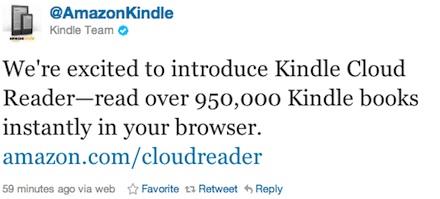
 We all know that Apple is quite greedy on the App Store. Moreover, Apple is explicitly forbidding applications from including a ‘buy’ button within the apps themselves that link to an external payment flow: this is why you can’t buy an ebook using Amazon Kindle App on the iPhone/iPad.
Shortly, Amazon was facing the same problem than Financial Times and it looks like they come across the same solution: bye-bye App, welcome HTML5.
The Kindle Cloud Reader is already live, although “limited” to Chrome and Safari web browsers and iPad.
 Well done, Amazon!
 Simone Calamai