A Visual History of Twitter

Twitter was launched in the summer of 2006 and became a hit during the 2007 SXSW seminar. Four years onwards, Twitter has become the leader in microblogging and is now more popular than ever. The infographic below details Twitter’s most influential content creators, staggering adoption rates, and struggle to turn a profit. An impressive overview of five exciting years.

Click on the image to open the full infographic (source: Mashable)Twitter Visual History

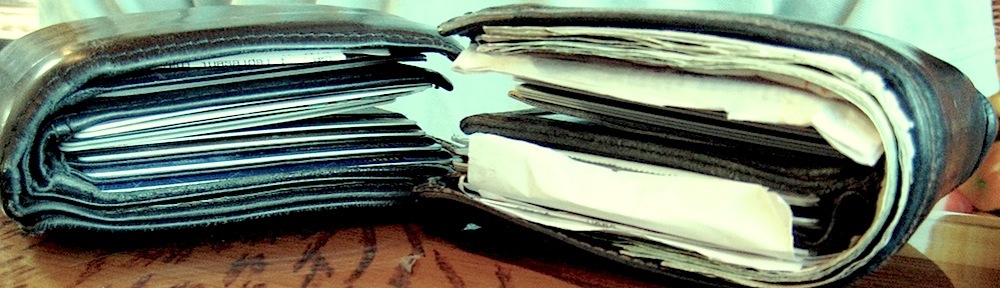
You too have a wallet like this? ;)

Stop And Give Me Your Wallet!

Google has finally launched the Wallet app, although service seems a more appropriate definition. You can pay and save using your mobile phone and near field communication (NFC). The first version of the app is released to Sprint only. That means Google is deploying Wallet to all Sprint Nexus S 4G phones through an over-the-air update.

Matt Buchanan of Gizmodo has already given the service a try. Although it does not look so seamless as “tap’n’pay”, it could really be revolutionary.

As Google states:

Our goal is to make it possible for you to add all of your payment cards to Google Wallet, so you can say goodbye to even the biggest traditional wallets.

Think about all the countries where the usage of plastic money is not so popular, resulting with huge problems of transactions’ traceability. It is an established fact that countries with more electronic transactions have smaller shadow economies and, consequently, lower tax evasion rates. This is one of the key factors behind the current sovereign debt crisis affecting quite a bunch of european developed countries where, in a typical vicious circle scheme, more and more people are inclined to work outside the normal, legal framework as their country’s economy continues to struggle.

Shadow economy as % of GDP, European countries, 2010

Shadow economy as % of GDP, European countries, 2010

From the consumer perspective, the most common excuse for not using debit/credit cards when making little payments is that it is not convenient or fast enough. Besides the fact that today it is more likely to forget at home the wallet rather than your mobile, paying with the smartphone introduces the speed factor in the transaction and, above all, it’s cool (i.e. fashionable = network effect).

Don’t get me wrong. I am not saying that NFC will solve the Eurozone crisis: I am a nerd but not that much 😎 From that point of view it is going to be just a drop in the bucket, but it surely is a step in the right direction.

In any case, we have some time to think about it: Google Wallet currently works only in the US on Nexus S 4G devices of the Sprint network. In the meantime, check out the official Google Wallet launch video.

Oddjob

Odd Job(s)

A young boy collecting funds for karate lessons

Have you read my previous post on the US Postal Service problem aka How to cope with human work replaced by technology? Unless an external source of funding comes in, the USPS will have to scale back its operations drastically, or simply shut down altogether. That’s 600,000 people who would be out of work, and another 480,000 pensioners facing an adjustment in terms. Huge numbers. And these issues are going to multiply as many human jobs/tasks will become obsolete due to technology shifts.

Douglas Rushkoff, a media theorist, in a special to CNN says that it’s not about jobs, it’s about productivity models. In other words, it is not a matter of demand and supply of jobs: actually, employment is abundant but we need

a way of fairly distributing the bounty we have generated through our technologies, and a way of creating meaning in a world that has already produced far too much stuff.

Can we organize the society around something other than employment? That is, can we find a third way NOT in the middle between communism and libertarianism in order to shift

the spirit of enterprise we currently associate with “career” to something entirely more collaborative, purposeful, and even meaningful?

Think about social networks. No, I don’t mean logging to Facebook to brag your last caribbean trip. I mean, networks of people who shares ideas, culture, know-how, time. In a single word, work. Not ego-boosting.

We have this idea that we put all this stuff out there and what we get back are intangible or abstract benefits of reputation. But why could not this be monetized?

Why can’t there be a universal marketplace where people could buy and sell bytes from each other, where information would be paid for? It would be much greater than the sum of parts: a future where people could make a living and earn money from what they did with their hearts and heads in an information system, the Internet.

Is the Information Age really replacing Industrial Age?

It seems so, but, IMHO, none of the so-called Internet giants is genuinely addressing this paradigm shift. Consequently, the question is not only “when”, but “how”.

Any hints? 💡

Rumble!

Mobile Patent Suits (again?)

Dilbert.com

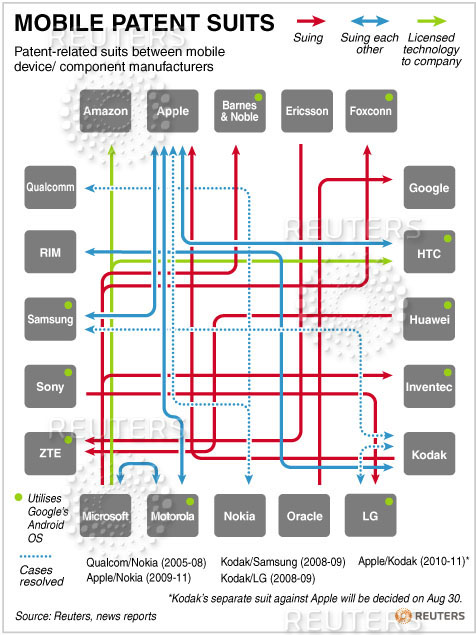
Who’s suing who? Perhaps this chart (courtesy of Reuters) will help make sense of the whole mess. Or maybe not. It looks like a giant spaghetti bowl.

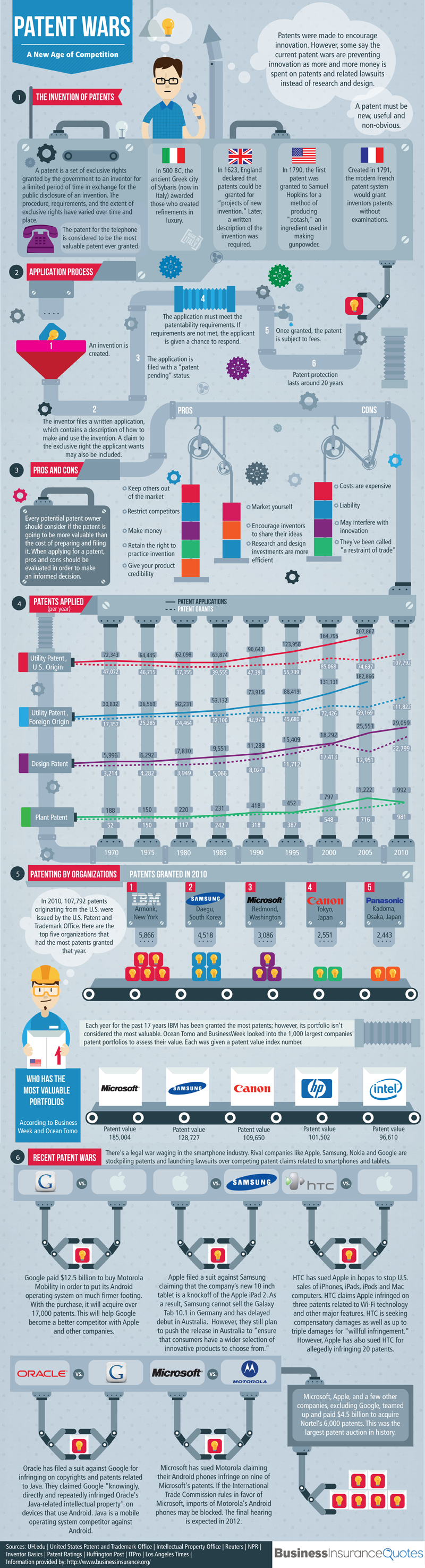
Mobile Patent Suits ChartIf you don’t know what I am talking about, take a look at this gorgeous infographic on Business Insurance Quotes:

Courtesy of BusinessInsurance.org

Courtesy of BusinessInsurance.org

I Watch You Back

Human TVSoon­­­, the websites you visit while watching TV could adapt in real time to the shows being watched — automatically presenting information relevant to the show, or even tuning their ads in response to what’s on screen.

Flingo, which developed the technology, known as Sync Apps, says the new set is already being mass-produced by one of the top five television brands in the U.S. and will retail for less than $500.

A new type of Internet-connected television, due out before the end of the year, has built-in software and hardware that send data about what is on-screen to an Internet server that can identify the content. Web pages being viewed using the same Internet connection as the TV set can then tap into that information. The system can identify any content onscreen, whatever the source, whether live TV, DVDs or movie files playing from a computer.

Ashwin Navin, Flingo’s CEO, says he expects people to opt in because the service offers an automatic way to do what people are already doing manually.

Source and original article: Technology Review