Think Different

Apple will not wait to see what the market wants

The announcement that Steve Jobs is to resign as Apple’s CEO should come as no surprise.

There is no doubt the influence of Jobs has been hugely important in making Apple the company it is today.
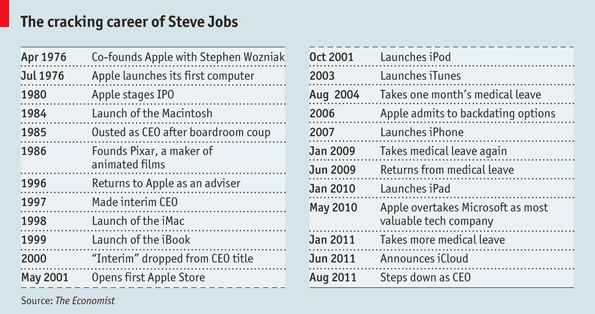
Steve Jobs career (source: The Economist)

However, IMHO will continue its onward march, not least because the market has been well aware of Jobs’ health issues and there is certainly no ‘Jobs premium’ built into Apple’s valuation.

It is not by chance that Apple is the success it is. This is a company that:

  1. has a strategy well in place for the mid-term
  2. is dominant in the tablet market – a market that has barely considered adolescence let alone maturity
  3. is leader in the smart phone market
  4. though it still only has single figure market share in the PC market, IMHO will continue to take share.

This company does not wait to see what the market wants – it creates what the market did not know it wanted but when it has it, it wants more. It will continue so to do.
It also have a strong competitive position: Apple has developed some quite unique barriers to entry through the iTunes store and the AppStore – which has the effect of creating much ‘stickier’ customers. Additionally, through being vertically integrated they can now not only produce the best product but can do so at the best prices – their competitors are desperately struggling to match the iPad price without making losses.

For sure, Apple will not be better without Steve Jobs but I hope that he has injected enough of his DNA into the company to let her continue this success story without him.

All the best to Tim Cook, new CEO, who has already proved himself extremely capable.

Other interesting articles on the same subject:

Freakonomics: Was Steve Jobs’ Retirement Already Priced into Apple Stock?

The Economist: Steve Jobs resigns. The minister of magic steps down

Nokia: The Loud, The Small and The Bright

Somebody has to stop them.
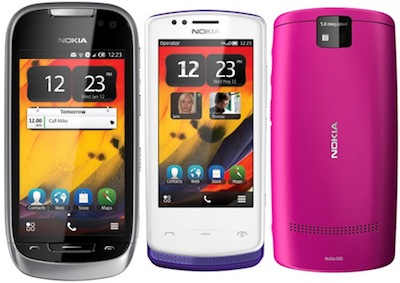
Nokia has released three new phones.

What?“, you could say, “Is the Android-killer Iphone-slasher Windows-equipped device already out?

Nope. They all come with Symbian OS but, hey, it’s the new version – called Symbian Belle .

Nokia claims that the 701 has the brightest phone screen the world has ever seen. The 600 is their loudest smartphone to date. The tiny 700 is the smallest monoblock phone on the market. Sounds good, uh? Well, you can’t judge a book by its cover but…

Nokia Symbian Belle Phones

Really, Nokia: stop that. We don’t want these to be your final days. Gizmodo is begging you too:

Then Nokia up and comes out with three new Symbian phones today. QUIT IT. Seriously. Finland. Do you read me? Stop making Symbian handsets. Repeat: kssshhhh Stop making Symbian handsets. Save your money for the Mango models. Wow us in October with something unexpected: competition for the iPhone. I’ll switch in a hummingbird’s heartbeat. And I won’t be alone.

Bye Bye Post Office

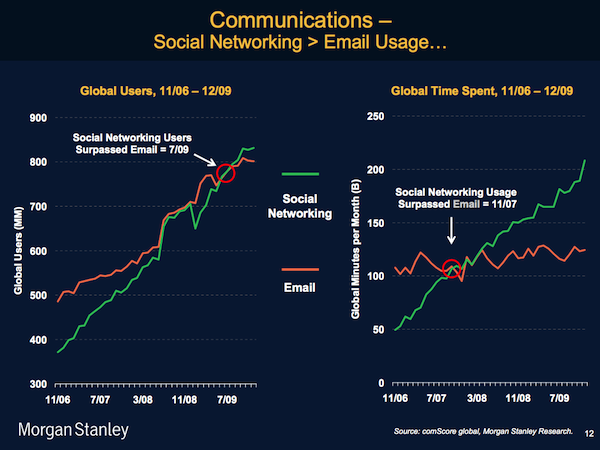
Remember one of the most retweeted chart of 2010? It was ripped off the Morgan Stanley’s Internet Trends presentation, and showed how social networking messaging systems have already surpassed email usage:

Chart from MS Internet Trends 2010 presentation

Whether it’s Twitter, Facebook, or some other social networking service, I believe the lighter weight communication paradigm (say less, reach more) is superior to email for many things. Nonetheless, email’s usage is still growing and IMHO is more suitable for long-form serious private conversations.

You may think that this trend is affecting only the way we send and receive messages on the web. What about the old, tangible, bunch of papers we find in our real mailbox? The Economist has a nice article depicting the volume of mail handled by the US Postal Office:

USPS - Letters no more

As ever more Americans go online instead of sending paper, the volume of mail has been plummeting […] Delivery costs are simultaneously going up. As a result, the post has lost $20 billion in the last four years and expects to lose another $8 billion this fiscal year […] As Christmas cards have gone online (and “green”), so have bills. In 2000, 5% of Americans paid utilities online. Last year 55% did.

USPS is planning to close post offices; up to 3,653, out of about 32,000. This month it announced plans to lay off another 120,000 workers by 2015, having already bidden adieu to some 110,000 over the past four years (for a total of about 560,000 now). It also wants to fiddle with its workers’ pensions and health care.

The post will have to stop delivering mail on Saturdays. Then perhaps on other days too.

USPS was born “to bind the Nation together”. Now it looks like there is a substitute: Internet.

Googlerola

Googlerola: my 2 cents

In these last days, I have tried to figure out what the outcomes of the Googlerola affair could be. There are at least four aspects to be considered:

  1. The size: 12.5B$ is A LOT of money (Motorola’s capitalization was around 7B$ when the deal came to the public);
  2. The timing: the announcement was made just in the middle of the patent war involving Google, Apple and Microsoft. Although it is difficult to imagine that such a deal has been settled in a few weeks, Page’s announcement seems to be a real timebomb;
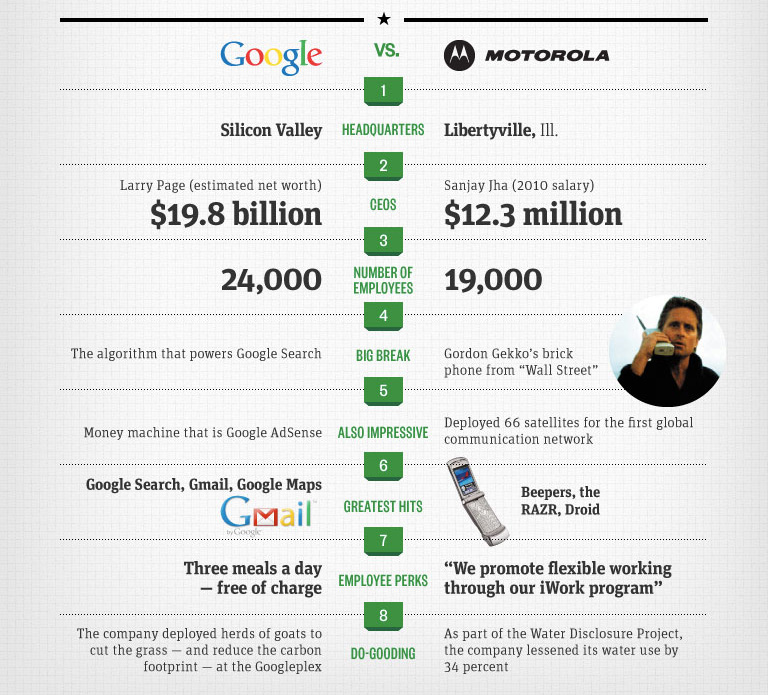
  3. The number of individuals involved: Google is a 30,000-people company; Motorola has 19,000 employees. The simple sum gives 50,000: a really huge number. Moreover, corporate culture is fundamental in the Google development process: without massive layoffs, Google will have 40% of its employees not respecting the Mountain View standards;
  4. The role of Google in the Android Open Handset Alliance: now the hardware manifacturers have a new player to deal with.

There are already tons of different opinions on the still-to-be-approved acquisition, including ferocious critics (read Henry Blodget foreseeing a “colossal disaster”).

I decided to stick to what Steven Levy says about it. Despite his closeness to Google (Did you read “In the Plex“? You should!), the decision to buy Motorola seems to have caught Levy by surprise.

Just a couple of hours after the Larry Page’s announcement, Levy had a quite long conversation with Business Insider. There is the link to that article at the bottom of this post, but I’d like to highlight a few words from Levy:

On price:

I wouldn’t have predicted that Google would have bought Motorola but it’s not surprising because Google likes to take big bets and make big leaps.

On timing:

Certainly it’s characteristic of Larry. If he has a situation to deal with, he’ll come up with the biggest possible response because big responses and big risks is part of his makeup.

On people:

Why wouldn’t Google want to make the workforce of its new company reflect its own values which would mean getting rid of some people and bringing on other people. Larry Page vets every single employee hired at Google, do you think he’s going to take on 19,000 employees and not care about how they perform or how well they meet his standards?

On Open Handset Alliance:

Google’s invested in the Android system and it has to make sure its partners feel secure in adopting that system. I don’t know if it’s total indemnification, or if it’s just help. To me, the one thing that makes this thing go down palatably to places like Samsung and HTC, is that they’re going to benefit by Google having this patent portfolio, this protection.

Read the full article on BusinessInsider.

MMQ6UHNZYGT4

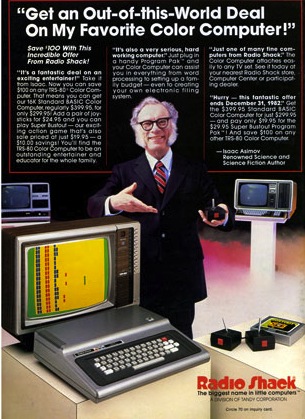
Asimov Radio Shack Ad

IBM kisses PC goodbye

Isaac Asimov's RadioShack AdIBM CTO Mark Dean, one of a dozen IBM engineers who designed the first PC unveiled Aug. 12, 1981, says PCs are:

“[…]going the way of the vacuum tube, typewriter, vinyl records, CRT and incandescent light bulbs.
PCs are being replaced at the center of computing not by another type of device — though there’s plenty of excitement about smartphones and tablets — but by new ideas about the role that computing can play in progress.
These days, it’s becoming clear that innovation flourishes best not on devices but in the social spaces between them, where people and ideas meet and interact. It is there that computing can have the most powerful impact on economy, society, and people’s lives”.


Source and original article: Networkworld.com