Signals and Frequencies

From the Internet of Things (IoT), where we are today, we are just beginning to enter a new realm: the Internet of Everything (IoE), where things will gain context awareness, increased processing power, and greater sensing abilities. Add people and information into the mix and you get a network of networks where billions or even trillions of connections create unprecedented opportunities and give things that were silent a voice.

Cisco defines IoE as bringing together people, process, data, and things to make networked connections more relevant and valuable than ever before—turning information into actions that create new capabilities, richer experiences, and unprecedented economic opportunity for businesses, individuals, and countries. (On Cisco POV, see also the video at the end of this post).

As more things, people, and data become connected, the power of the Internet (essentially a network of networks) grows exponentially. (See Metcalfe’s Law and Network effect).

A full realization of IoE will require some key enabling factors. In my opinion, the most crucial ones will be IPv6 implementation and, above all, a brand new software engineering approach. The manner in which software is developed hasn’t fundamentally changed since the 1960s. The orchestration of a paradigm shift is essential if the software industry is to ever become at least as innovative and productive as the hardware industry, which is following Moore’s Law. A new software science approach needs to be established to meet the requirements for the emerging IoE of unattended devices.

More on this subject:
What is the ‘Internet of everything’? – Answered by Peter H. Diamandis
Gartner Symposium: CIOs, Get ready for the IoE
old-new-thermo-feat

U.I.O. – Uniquely Identifiable Objects

Over the next 10 years, the physical world will become ever more overlaid with devices for sending and receiving information […] With the continuing exponential increase in the power of the planetary computer, one has to wonder whether we stand at the beginning of what Isaac Asimov’s “Foundation” series, more than 60 years ago, called “psychohistory.” His visionary genius Hari Seldon believed that statistical forecasting of human society’s actions would be possible with data from enough people throughout the galaxy.
In the next several decades, we will have a glimpse of whether something similar can emerge on planet Earth.

Larry Smarr: An Evolution Toward a Programmable Universe

Business Insider predicts that in 2012 we will see a lot of hype around The Internet Of Things. True or not, as a matter of fact, the also called Industrial Internet is already here. Across many industries, products and practices are being transformed by communicating sensors and computing intelligence. Low-cost sensors, clever software and advancing computer firepower are opening the door to new uses in energy conservation, transportation, health care and food distribution. The role of sensors — once costly and clunky, now inexpensive and tiny — was described this month in the NYT in the essay quoted at the beginning of this post (Larry Smarr is the founding director of the California Institute for Telecommunications and Information Technology).

Technology Roadmap The Internet of Things

Technology Roadmap: The Internet of Things (source: Wikipedia)

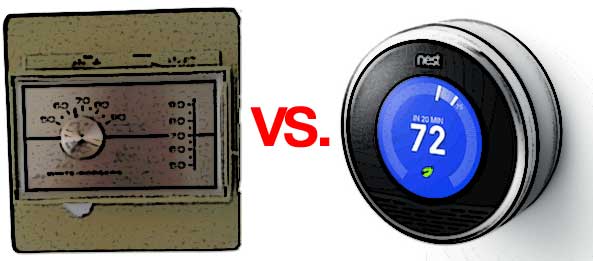
That may sound like blue-sky futurism, but evidence shows that the vision is beginning to be realized on the ground, in recent investments, products and services, coming from large industrial and technology corporations and some ambitious start-ups. One of the hot new ventures in Silicon Valley is Nest Labs, founded by Tony Fadell, a former Apple executive, which has hired more than 100 engineers from Apple, Google, Microsoft and other high-tech companies. Its product, introduced in late October, is a digital thermostat, combining sensors, machine learning and Web technology. It senses not just air temperature, but the movements of people in a house, their comings and goings, and adjusts room temperatures accordingly to save energy.

From this perspective, the consumer Internet (the one we are already accustomed to) can be seen as the warm-up act for these technologies. Think about software techniques like pattern recognition and machine learning used in Internet searches, online advertising and smartphone apps that are also ingredients in making smart devices to manage energy consumption, health care and traffic. Take Google’s driverless car, for example.

The automated cars, each with a human along for the ride, have deftly navigated thousands of miles on California highways and city streets. The project — a research effort so far — uses a bundle of artificial intelligence technologies, as does Google’s Search and AdWords/AdSense business.

In such a smart world, the real dilemma will rather be finding the right trade-off between society’s efficiency, innovation and (guess what?) control. We can only hope that politicians will be capable of dealing with such problems.