John Maynard Keynes

Sovereign Wealth = Sovereign Power? (2/2)

Second and final part of a short essay I wrote in 2009 (but still relevant in many aspects). Here you can find the first part and all the details.

A new world order (continued)

The rise of emerging economies (China, India and Russia on all) emphasizes the fact that in a growing proportion of the world economy, the state governance plays a fundamental role in allocating resources for international investment. In the last twenty years, the political leaders of Western countries have followed the dictates of Ronald Reagan and Margaret Thatcher, trying to subtract as much as possible the influence of the government from economic life. Markets should be working (only) on three key principles: Privatisation, Liberalisation and Deregulation. However, the problems faced by the financial markets since the end of 2006 following the outbreak of the subprime mortgage bubble, have brought black clouds on the “market-only approach” to modern capitalism. After the near collapse of the U.S. and EZ banking system and the serious problems posed by the world credit crunch, on the horizon is looming the return to state governance crucially more involved in international economic and financial affairs.

In other words, we are finally beginning to understand that the dichotomy that opposes the “more government, less market” to “more market, less government” is false, and that the historic changes set in motion by globalization and technological revolution require much more complex response of the old-fashioned statism or of a liberism preaching the “laissez-faire capitalism”. Probably, the answer can be found in the scheme “more government, more market”, meaning for “more government” not necessarily a stronger presence of public money, but certainly a stronger ability to determine policies, indicating the strategic guidelines to move the productive forces, and for “more market” a set of simple rules that should ensure the greatest possible transparency to the dynamics of profit.

Somebody may wonder if that could mean a return to a Keynesian economic system. In my humble opinion, the theory of John Maynard Keynes cannot be proposed “as is”. Instead, if returning to Keynesianism means the rediscovery of the need to definitively overcome the dichotomy liberalism – statism, and recovering the role of public policies in the market, then it is useful and appropriate to return to speak of the man who is rightly considered the father of modern macroeconomics. With his theories, Keynes argued the need for regulatory intervention by the state, primarily by using the instruments of monetary policy and credit. His thinking is certainly useful when reasoning about the future of globalization: there is no doubt, in fact, that we have entered a sort of “phase two” of the process of integration of global economies and markets, and this season should not be characterized from a return to protectionism, but from the definition of common rules and new world organizations that go beyond technical ones, such as IMF and World Bank, and political ones, such as various G7-G20 .

Here is a very convincing statement of Dani Rodrik of Harvard University [click for reference]

The first three decades after 1945 were governed by the Bretton Woods consensus — a shallow multilateralism that permitted policymakers to focus on domestic social and employment needs while enabling global trade to recover and flourish. This regime was superseded in the 1980s and 1990s by an agenda of deeper liberalisation and economic integration. That model, we have learned, is unsustainable. If globalisation is to survive, it will need a new intellectual consensus to underpin it. The world economy desperately awaits its new Keynes.

new-day-dawn

Sovereign Wealth = Sovereign Power? (1/2)

In 2009 I wrote some papers for the department of social sciences at the University of Florence. Among these, the main study was on the Sovereign Wealth Funds “phenomenon”. The field I was approaching was History of International Economic Relations. Rereading my work, I realized that I still think the same about the possible answers to the questions posed by the (supposed?) new world order. Here’s what.

A new world order

Towards the end of the nineteenth century, the borders of Britain’s financial empire went well beyond politics. The dependence of a country from English economic power was ahead, more or less formally, to the submission to political power. When the Egyptian Khedive had the need to raise cash to cover his personal debt in respect of some British private banks, he could do nothing but sell its shareholding in the Suez Canal Company. The Khedive certainly did not act better when it came to managing the Egyptian public debt: the difficulty in honouring it brought England and France to take control of the Egyptian Treasury, and finally, in 1882, Egypt was put under military occupation. [click for reference]

In 1956, the decision of Egyptian President Gamal Abdel Nasser to nationalize the Suez Canal Company (owned by an Anglo-French coalition) provided to UK and France a justification for organizing a joint military operation against Egypt, which led to the occupation of the Channel from England (along with France and Israel, with the latter having joined the conflict on the side of the European powers). The financial status of the UK, however, was no longer that of the previous century: Britain had indeed a small current account surplus, but in 1956-57 the pound sterling had become subject to speculative pressures. The Bank of England made extensive use of its dollar reserves to support the exchange rate existing between the pound and the dollar, but came to a point where the threat of a forced devaluation or a change to a flexible exchange rate system was real. The United States, then the largest single creditor of Great Britain, declared that their intention to continue to provide direct financial support to England and to participate in an IMF loan for the United Kingdom, would depend to the compliance by British government with a UN General Assembly resolution calling on the United Kingdom, France and Israel to withdraw from the Suez Canal. [click for reference]

The American ultimatum forced Britain to reconsider its position. Anthony Eden, then British prime minister, explained that:

We were therefore faced with the alternatives, a run on sterling and the loss of gold and dollar reserves till they fell well below the safety margin […] or make the best we could of UN takeover and salvage what we could. [click for reference]

The lesson which follows from the the Suez crisis should be, especially for the United States, rather obvious: political strength is (almost always) related to financial strength. For example, the capabilities of a debtor country to carry out military actions depend largely on the support provided by creditor countries. Militarily, the United States are stronger today than it was Great Britain in the ’50s and are also not obliged to keep the dollar exchange rate to a predetermined level. However, in other respects, US financial position is more precarious than English one at the time of the Suez crisis. Indeed, while in 1956 the English had even a small current account surplus, the United States, at the end of 2010, had a current account deficit of about $ 120 billion, i.e. -3.2% of their GDP. Furthermore, Britain’s main creditors were British political and military allies (the United States on all) while, on the other side, U.S. debt, is not funded by “allies”: without investments in U.S. government securities made by China, Russia and the Gulf countries, the dollar would suffer a substantial depreciation, boosting U.S. interest rates. This would be difficult to sustain for the United States, because it would put entirely on the shoulders of the domestic economy the cost of maintaining their international role.

After all, it seems that the U.S. have the ability to borrow huge amounts of money at very favourable rates. Their dependence on foreign financing could be considered not as vulnerability, but as a sign of strength on the international scene: simply, the American economy could be too big to fail.

Actually, one could suggest the opposite, namely that the growing U.S. current account deficit represents a strategic (read: political) understated vulnerability. The willingness of central banks in emerging countries to accumulate dollar reserves has provided a stable source of debt financing. The problem is that these central banks already hold far more reserves than they need, so that they can also be used to finance new investment vehicles (Sovereign Wealth Funds, in fact). True, central banks still have an interest in maintaining the dollar relatively strong, but the U.S. may have more to lose than to gain from a possible “showdown” with the monetary authorities in creditor countries. In a nutshell: the more the U.S. will continue to base their economy on deficit financed by the investment vehicles in emerging countries (central banks and sovereign wealth funds), the more they will reduce their strength on the international stage.

In addition to that, it can be observed that the economic weight of China, India, Russia, Brazil, Arab States of the Gulf and other emerging economies will increase in the twenty-first century. Also if China’s growth were to grow at a slower pace than the current, it is likely that China, over the next twenty-five years, will displace the U.S. as the largest economy in the world. [click for reference]

This step alone would involve substantial changes to the world economy and to institutions which are responsible for the global governance. At the moment, however, the increase in the relative economic importance of these new actors is accompanied by another dramatic change: the emerging economies have become creditors of the industrialized countries.

This flow of state capital appears more and more as the consequence of political choices rather than the natural evolution of the global economy. Indeed, the size of Chinese population suggests that China should be the first economy in the world and not the largest creditor of the West! Moreover, the weight of the U.S. foreign debt, concentrated in a limited number of counterparties – many of which do not share the Western democratic values – undeniably represents a strategic vulnerability. This certainly does not mean that these creditors will improperly use their “bargaining power”, but the United States should act to avoid the possibility that a foreign country, for example, could suddenly reduce its dollar investments as a response to a foreign policy dispute. Given the magnitude of the american debt position, this could cause a shock to the U.S. economy no less severe than that following the subprime credit crisis. (… here is the second part)

Occupying the Internet, too?

Shortly after publishing my last rants on the strong concentration of global corporate control (see ‘Eye in the Sky‘), I came across this article on the Darren Herman blog.

Trying to figure out what the online media spend looks like, here is what he uncovered:

the digital media ad spend (search, display, mobile, etc) controlled by Google, Yahoo, Microsoft, Facebook, and AOL is about $40.1B

According to a recent ZenithOptimedia press release, worldwide digital advertising accounted for about $64.03B. That means that those ‘five sisters’ mentioned above, in that order, account for more than 60% of the worlds digital media ad spend. Moreover,

Google generates approximately 364% more revenue from advertising than it’s next closest rival, Yahoo!

To push this inequity even further, if you look at the comments in Herman’s blog post, Jon Steinberg (the President of BuzzFeed), points to another staggering statistic: 75% of all advertising spend is controlled by four advertising networks: WPP, Omnicom, Publicis and Interpublic (see his Flickr image here).

I’ll keep this in mind the next time I will be talking with someone of things such as concentration and dominant position. Apparently, these concepts also apply to the business models ruling the Internet. Which is something more difficult to occupy than any Wall Street.

Eye in the Sky

Eye in the Sky

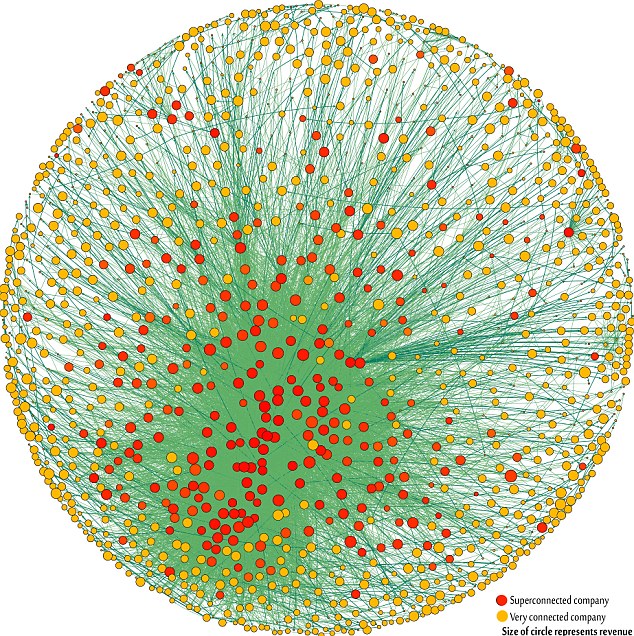
The idea that a few bankers control a large chunk of the global economy might not seem like news to New York’s Occupy Wall Street movement and protesters elsewhere. But the study by a trio of complex systems theorists at the Swiss Federal Institute of Technology in Zurich is the first to go beyond ideology to empirically identify such a network of power. It combines the mathematics long used to model natural systems with comprehensive corporate data to map ownership among the world’s transnational corporations (TNCs).

The study determines that global corporate control is far more concentrated than many people think: a core of just 147 firms — many of them financial companies — control 40 percent of the wealth of 43,060 transnational corporations. A broader core of 737 control 80 percent, according to the theorists.

Map of the 1,318 companies at the heart of the global economy

Creating a ‘map’ of 1,318 companies at the heart of the global economy, the study found that 147 companies formed a super entity within this, controlling 40 per cent of its wealth. All own part or all of one another. Most are banks – the top 20 includes Barclays and Goldman Sachs. But the close connections mean that the network could be vulnerable to collapse.

In effect, less than one per cent of the companies were able to control 40 per cent of the entire network

says James Glattfelder, a complex systems theorist at the Swiss Federal Institute in Zurich, who co-wrote the research.

Some of the assumptions underlying the study have come in for criticism – such as the idea that ownership equates to control. But the Swiss researchers simply applied mathematical models usually used to model natural systems to the world economy. Moreover, the value of the study wasn’t to see who controlled the global economy, but the tight connections between the world’s largest companies. The financial collapse of 2008 showed that such tightly-knit networks can be unstable.

If one company suffers distress, this propagates

Glattfelder says.

The data used by the Swiss theorists was from 2007. IMHO that ownership is even more concentrated now. For example, Barclays is at the top of the list from the 2007 data. But Lehman Brothers, which was acquired out of bankruptcy by Barclays, is also on the list. The global financial consolidation that followed the financial crisis has only made the concentration worse.

The top 50 of the 147 superconnected companies

1. Barclays plc
2. Capital Group Companies Inc
3. FMR Corporation
4. AXA
5. State Street Corporation
6. JP Morgan Chase & Co
7. Legal & General Group plc
8. Vanguard Group Inc
9. UBS AG
10. Merrill Lynch & Co Inc
11. Wellington Management Co LLP
12. Deutsche Bank AG
13. Franklin Resources Inc
14. Credit Suisse Group
15. Walton Enterprises LLC
16. Bank of New York Mellon Corp
17. Natixis
18. Goldman Sachs Group Inc
19. T Rowe Price Group Inc
20. Legg Mason Inc
21. Morgan Stanley
22. Mitsubishi UFJ Financial Group Inc
23. Northern Trust Corporation
24. Société Générale
25. Bank of America Corporation
26. Lloyds TSB Group plc
27. Invesco plc
28. Allianz SE
29. TIAA
30. Old Mutual Public Limited Company
31. Aviva plc
32. Schroders plc
33. Dodge & Cox
34. Lehman Brothers Holdings Inc*
35. Sun Life Financial Inc
36. Standard Life plc
37. CNCE
38. Nomura Holdings Inc
39. The Depository Trust Company
40. Massachusetts Mutual Life Insurance
41. ING Groep NV
42. Brandes Investment Partners LP
43. Unicredito Italiano SPA
44. Deposit Insurance Corporation of Japan
45. Vereniging Aegon
46. BNP Paribas
47. Affiliated Managers Group Inc
48. Resona Holdings Inc
49. Capital Group International Inc
50. China Petrochemical Group Company
* Lehman still existed in the 2007 dataset used

The full study is available in PDF format:
S. Vitali, J.B. Glattfelder, and S. BattistonThe network of global corporate control (2011)

USA Inc.

Kleiner Perkins venture capitalist Mary Meeker wows the technology business world every year with dazzling presentations on the state of industry.

This year at Web 2.0 summit in San Francisco, she did it again.

The complete slideshow (see above) is insightful as usual, and it goes through the present and foreseeable internet trends, with a particular attention to the mobile phenomenon – she’s been focusing on mobile the past few years.

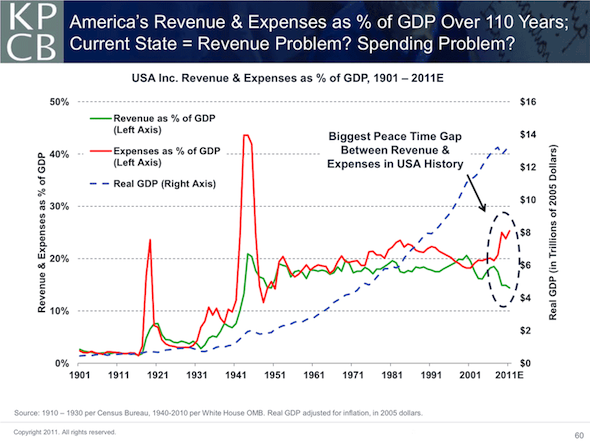
However, the last part of the presentation is dedicated to USA Inc., a look at the US federal government as if it were a business. As Meeker states in the intro of the original USA Inc. report:

Imagine for a moment that the United States government is a public corporation. Imagine that its management structure, fiscal performance, and budget are all up for review. Now imagine that you’re a shareholder in USA Inc. How do you feel about your investment? Mary Meeker USA Inc. Report, Feb. 2011

Well, looking at slide 60, If I were an American citizen, I would not feel good at all.

America's Revenue and Expenses as % of GDP in the last 110 years

How to fix this issue? Depending on the solutions, we will have very different social and economic situations.

And, probably, a new U.S. president.

Google Plus… Plus What?

Google has announced its earnings for Q3 2011. Impressive numbers, as always: two-digit percentage growth almost everywhere, and a pile of more than 45$B in cash. Everything comes off of search revenue.
The same good ol’ story.

Everyone was expecting a few more insights on the Android business and on the Googlerola affair. Nope. Not a single word.

However, they did confirm that Google+ has over 40 million users. And a lot of surprises still to show. Larry Page has outlined the significant effect he foresees Google+ will have on the company’s business.

Our ultimate ambition is to transform the overall Google experience — making it beautifully simple, almost automagical, because we understand what you want and can deliver it instantly.

This means baking identity and sharing into all of our products so that we build a real relationship with our users. Sharing on the web will be like sharing in real life across all your stuff. You’ll have better, more relevant search results and ads. [ed.: see a previous post on the possible implications of Google’s +1]

Of course, now comes the hard part: developing Google+ in a manner that leads it to attain a critical mass of users and makes it a real contender to Facebook.

On this side, IMHO, success is far from certain:

  1. Google+ Has 40 Million Users, But How Many Use It?
  2. Google+ will never beat Zuckerberg on his own turf. There are plenty of reasons, all well summarized in this article on Gizmodo
  3. Data analytics company Chitika recently published results of a study that revealed that Google+ traffic has deflated, following a spike after the social networking service came out of a limited beta on Sept. 20, and fallen back to the usage level it had before becoming publicly available
  4. It also looks like there are some Googlers not sharing the optimism of their CEO. A couple of days ago, a Google engineer named Steve Yegge mistakenly published publicly a post in which he leveled some sharp criticism at Google+, calling it “a knee-jerk reaction, a study in short-term thinking” in large part because it lacks a strong developer platform.
  5. Until now, the approach of Google to social networks has been, to say the least, controversial. Orkut is used in Brazil only (but Facebook is growing at a light-speed pace), and they have just decided to shut down Buzz.

So, how is Google going to conquer the world with Google+? Is the Big G really going to put Google+ at the center of its existence and rebuild its other products around it? It’s sounds radical, but that’s precisely what Google seems to be willing to do. Page said

We shipped the ‘Plus’, and now we’re going to ship the Google part.

Recommendations are key tools in marketing, and +1 and Google Plus could really become the automated version of word of mouth that is supposed to sit atop search engines. Nonetheless, it’s a gamble to build your core business on a social network that’s a few months old and only has 40 million users. But it will be fascinating to see Google strive to make Google+ the formidable pivot of the ecosystem that Page envisions.

Meanwhile, sit down and relax: we still have to see what the outcomes of Facebook’s “curated search” patent will be…