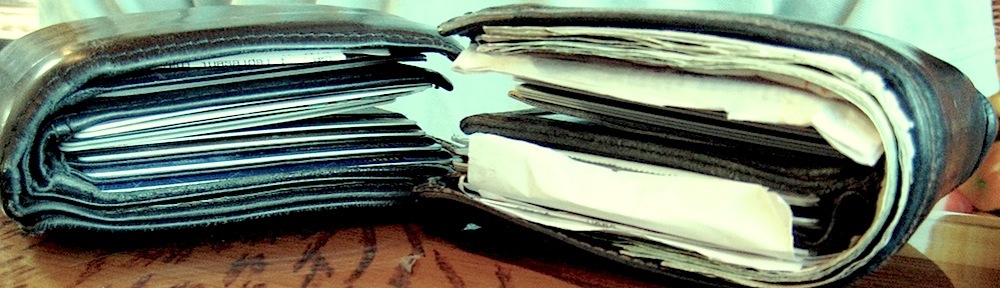
You too have a wallet like this? ;)

Stop And Give Me Your Wallet!

Google has finally launched the Wallet app, although service seems a more appropriate definition. You can pay and save using your mobile phone and near field communication (NFC). The first version of the app is released to Sprint only. That means Google is deploying Wallet to all Sprint Nexus S 4G phones through an over-the-air update.

Matt Buchanan of Gizmodo has already given the service a try. Although it does not look so seamless as “tap’n’pay”, it could really be revolutionary.

As Google states:

Our goal is to make it possible for you to add all of your payment cards to Google Wallet, so you can say goodbye to even the biggest traditional wallets.

Think about all the countries where the usage of plastic money is not so popular, resulting with huge problems of transactions’ traceability. It is an established fact that countries with more electronic transactions have smaller shadow economies and, consequently, lower tax evasion rates. This is one of the key factors behind the current sovereign debt crisis affecting quite a bunch of european developed countries where, in a typical vicious circle scheme, more and more people are inclined to work outside the normal, legal framework as their country’s economy continues to struggle.

Shadow economy as % of GDP, European countries, 2010

Shadow economy as % of GDP, European countries, 2010

From the consumer perspective, the most common excuse for not using debit/credit cards when making little payments is that it is not convenient or fast enough. Besides the fact that today it is more likely to forget at home the wallet rather than your mobile, paying with the smartphone introduces the speed factor in the transaction and, above all, it’s cool (i.e. fashionable = network effect).

Don’t get me wrong. I am not saying that NFC will solve the Eurozone crisis: I am a nerd but not that much 😎 From that point of view it is going to be just a drop in the bucket, but it surely is a step in the right direction.

In any case, we have some time to think about it: Google Wallet currently works only in the US on Nexus S 4G devices of the Sprint network. In the meantime, check out the official Google Wallet launch video.

Quote of the Day

Quote of the Day | 2011, Sep. 20

From the Seth Godin’s Blog

For the first time in its history, the editors at The New Yorker know which articles are being read. And they know who’s reading them.

They know if the cartoons are the only thing people are reading, or if the fiction really is a backwater. They know when people abandon articles, and they know that the last 3,000 words of a feature on the origin of sand is being widely ignored.

They also know, or should know, whether people are looking at the ads, and what the correlation is between ad lookers and article readers. The iPad app can keep track of all of this, of course.

The question then: should they change? Should the behavior of readers dictate what they publish?

Of course, this choice extends to what you publish as well, doesn’t it?

[updated: I fear many people missed my points here. A. this isn’t a post about the New Yorker. and B. I’m not sure it should change. Perhaps it’s the stuff we don’t read that makes the rest of it worth reading. Racing to keep up with your readers and to pander to them might not be the best way to do work that matters. Sorry if I was insufficiently direct in my original notion. And yes, I’m aware of the irony of this update.]

Oddjob

Odd Job(s)

A young boy collecting funds for karate lessons

Have you read my previous post on the US Postal Service problem aka How to cope with human work replaced by technology? Unless an external source of funding comes in, the USPS will have to scale back its operations drastically, or simply shut down altogether. That’s 600,000 people who would be out of work, and another 480,000 pensioners facing an adjustment in terms. Huge numbers. And these issues are going to multiply as many human jobs/tasks will become obsolete due to technology shifts.

Douglas Rushkoff, a media theorist, in a special to CNN says that it’s not about jobs, it’s about productivity models. In other words, it is not a matter of demand and supply of jobs: actually, employment is abundant but we need

a way of fairly distributing the bounty we have generated through our technologies, and a way of creating meaning in a world that has already produced far too much stuff.

Can we organize the society around something other than employment? That is, can we find a third way NOT in the middle between communism and libertarianism in order to shift

the spirit of enterprise we currently associate with “career” to something entirely more collaborative, purposeful, and even meaningful?

Think about social networks. No, I don’t mean logging to Facebook to brag your last caribbean trip. I mean, networks of people who shares ideas, culture, know-how, time. In a single word, work. Not ego-boosting.

We have this idea that we put all this stuff out there and what we get back are intangible or abstract benefits of reputation. But why could not this be monetized?

Why can’t there be a universal marketplace where people could buy and sell bytes from each other, where information would be paid for? It would be much greater than the sum of parts: a future where people could make a living and earn money from what they did with their hearts and heads in an information system, the Internet.

Is the Information Age really replacing Industrial Age?

It seems so, but, IMHO, none of the so-called Internet giants is genuinely addressing this paradigm shift. Consequently, the question is not only “when”, but “how”.

Any hints? 💡

Marketing Online Serendipity

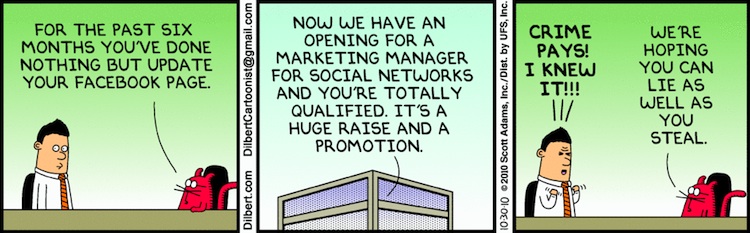
Dilbert.com - Oct. 30, 2010

From Dictionary.com

ser·en·dip·i·ty  /ˌsɛr ənˈdɪp ɪ ti/ –noun


1. an aptitude for making desirable discoveries by accident.


2. good fortune; luck: the serendipity of getting the first job she applied for.

In the offline shopping experience, this is quite common. You know, that feeling of walking into your favourite bookshop and picking something up in a section you don’t normally go into just because they rearranged the aisles. The moment when you stumble across some gorgeous shirt in a store you have never visited before, but your friend needed to ‘say hello’ to the salesgirl.

That magic moment where you discover something cool (and better than the others) by accident.

Or – as happened to me not so long ago – entering an hotel where you stayed only once a couple of months before and the concierge welcomes you by name.

In the online experience, things get a little bit more complicated.

Just like in the “real” world, online serendipity is a phenomenon where users encounter something they like that they were not expecting. We all know about targeting and segmentation: Amazon made a sort of 11th commandment of it (the “people like you buy stuff like this” functionality), and this has been replicated in thousands of platforms and marketplaces. Clearly, providing important and relevant information from your peers will help increasing conversion rates significantly.

But serendipity happens when you are not going for shopping.

Amazon’s lists (and the likes) never amaze. Serendipity gives you things that you weren’t looking for right now and suddenly you think: “OMG, I gotta have it!

In my opinion, the next phase will be to anticipate users’ questions and answer them before they are even asked. That’s the same kind of experience you have during your offline saturday afternoon shopping session, when you see something blinking at you from the window of that never-even-realized-it-was-there bazaar.

Social networks have a strong part to play here, but we need something more than rating and sharing to be genuinely surprised.

Google+, are you ready?

Crisis? Hem Your Pants!

After reading and writing tons of emails, tweets, articles about the financial (and economic) perfect storm that is hitting Europe and the US, I decided to take a break and concentrate myself for a while on some more basic issues 😎

For example, it looks like I have the same problem as The Sartorialist: which way to go when it comes to hemming your pants for the next AW season?  Scott shows three options:

Slim, and right at the ankle, no break Slim, past the ankle, with lots of break Above the ankle, with an extra wide cuff

I strongly prefer the first one, maybe with a touch of italian style (just add a 1.8″ cuff).

What do you think about it?