Media Megatrends 2012-2018

Media Megatrends 2012–2018

Charles Darwin once said:

In the long history of humankind (and animal kind, too) those who learned to collaborate and improvise most effectively have prevailed.

In an era of unprecedented change in the communications, entertainment, and information technology sectors, it is about Digital Darwinism and our ability to thrive. Our future rests on how well we anticipate, adapt, and capitalize on the exciting changes that lie ahead.

According to the  FutureMedia Outlook 2012, a downloadable annual report by Georgia Institute of Technology (see link below) on the future of media and its impact on people, business and society, in the next five to seven years the media landscape will be full of increased personalization, innovation, and flexibility.

Six megatrends will have a pervasive impact:

fox-64Smart Data
In an increasingly noisy world, we’ll have to sift, filter and be smarter about what matters.

people-64People Platforms
Beyond “true personalization,” they will be socially driven platforms made of algorithms from personal and associated data that people design and tailor themselves.

strawberry-64Content Integrity
Pervasive mobile devices, sprawling networks, clouds ,and multi-layered platforms have made it more difficult to detect and address our digital vulnerabilities, drawing us to trusted content sources.

speedy-64Nimble Media
Media is evolving from a set of fixed commodities into an energetic, pervasive medium that allows people to navigate across platforms and through different content narratives.

supermario-646th Sense
Extraordinary innovations in mixed reality will change the way we see, hear, taste, touch, smell and make sense of the world — giving us a new and powerful 6th sense.

collaboration-64Collaboration
We will harness the power of many in an increasingly conversational and participatory world.

The report includes demonstration clips and video interviews with leading Georgia Tech researchers offering real-world examples of how the Institute is innovating in these areas. You can find it here.


Same old saying: KISS!

I was browsing across the ‘new’ Twitter layout features (oh, by the way: did you know that T’s creative director, Doug Bowman, worked for Google? Here is his gentle but tough goodbye message to Big G), when I came across this:

Simplicity meets serendipity

[link here]

Given the title of this blog, you would admit my curiosity on the subject… It was then that I remembered the video of an interview with Jack Dorsey (creator and executive chairman of Twitter) about the existence of a business model founded on serendipity. How would I define it? Well, in a few words online serendipity is a phenomenon where users encounter something they like that they were not expecting (read my previous blog post on the same subject).

As Dorsey himself admits, Google AdWords has been the first application of this groundbreaking online marketing model. As with fashion magazines, where ads are so well integrated with the content to be not only pleasant but also useful to the consumer, AdWords has made online advertising reputable and even desirable.

In the same way that people believe that Google ads make the search experience better, Dorsey says that Twitter’s ad products – promoted trends, promoted accounts, and promoted Tweets – get engagement rates between 1 percent and 5 percent. And this is done, in fact, in an unconventional sense:

I don’t necessarily think of it as advertising in the traditional sense. It’s, how do we introduce you to something new? How do we introduce you to something that would otherwise be difficult for you to find, but something that you probably have a deep interest in discovering? It’s really just another algorithm, or it’s just more curation, but it’s something that you would find delight in anyway. [..] The user experience is what matters. If the user experience is bad, then we fail.

Now the key question is: How do you engineer a system that, while not literally random, produces the feeling of serenidipitous discovery, meaning emerging from what seems like meaninglessness? AdWords also works because it’s a natural part of the system. You perform a search in order to get results — some of those results come in the form of advertising.

If Twitter wants to fully rely on this business model, it must be sure that the strategy feels like it is natural part of the network.

Occupying the Internet, too?

Shortly after publishing my last rants on the strong concentration of global corporate control (see ‘Eye in the Sky‘), I came across this article on the Darren Herman blog.

Trying to figure out what the online media spend looks like, here is what he uncovered:

the digital media ad spend (search, display, mobile, etc) controlled by Google, Yahoo, Microsoft, Facebook, and AOL is about $40.1B

According to a recent ZenithOptimedia press release, worldwide digital advertising accounted for about $64.03B. That means that those ‘five sisters’ mentioned above, in that order, account for more than 60% of the worlds digital media ad spend. Moreover,

Google generates approximately 364% more revenue from advertising than it’s next closest rival, Yahoo!

To push this inequity even further, if you look at the comments in Herman’s blog post, Jon Steinberg (the President of BuzzFeed), points to another staggering statistic: 75% of all advertising spend is controlled by four advertising networks: WPP, Omnicom, Publicis and Interpublic (see his Flickr image here).

I’ll keep this in mind the next time I will be talking with someone of things such as concentration and dominant position. Apparently, these concepts also apply to the business models ruling the Internet. Which is something more difficult to occupy than any Wall Street.

Eye in the Sky

Eye in the Sky

The idea that a few bankers control a large chunk of the global economy might not seem like news to New York’s Occupy Wall Street movement and protesters elsewhere. But the study by a trio of complex systems theorists at the Swiss Federal Institute of Technology in Zurich is the first to go beyond ideology to empirically identify such a network of power. It combines the mathematics long used to model natural systems with comprehensive corporate data to map ownership among the world’s transnational corporations (TNCs).

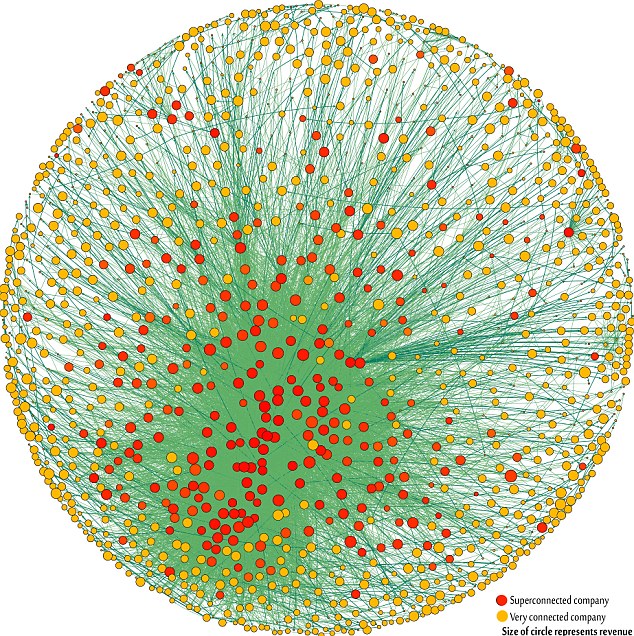
The study determines that global corporate control is far more concentrated than many people think: a core of just 147 firms — many of them financial companies — control 40 percent of the wealth of 43,060 transnational corporations. A broader core of 737 control 80 percent, according to the theorists.

Map of the 1,318 companies at the heart of the global economy

Creating a ‘map’ of 1,318 companies at the heart of the global economy, the study found that 147 companies formed a super entity within this, controlling 40 per cent of its wealth. All own part or all of one another. Most are banks – the top 20 includes Barclays and Goldman Sachs. But the close connections mean that the network could be vulnerable to collapse.

In effect, less than one per cent of the companies were able to control 40 per cent of the entire network

says James Glattfelder, a complex systems theorist at the Swiss Federal Institute in Zurich, who co-wrote the research.

Some of the assumptions underlying the study have come in for criticism – such as the idea that ownership equates to control. But the Swiss researchers simply applied mathematical models usually used to model natural systems to the world economy. Moreover, the value of the study wasn’t to see who controlled the global economy, but the tight connections between the world’s largest companies. The financial collapse of 2008 showed that such tightly-knit networks can be unstable.

If one company suffers distress, this propagates

Glattfelder says.

The data used by the Swiss theorists was from 2007. IMHO that ownership is even more concentrated now. For example, Barclays is at the top of the list from the 2007 data. But Lehman Brothers, which was acquired out of bankruptcy by Barclays, is also on the list. The global financial consolidation that followed the financial crisis has only made the concentration worse.

The top 50 of the 147 superconnected companies

1. Barclays plc
2. Capital Group Companies Inc
3. FMR Corporation
4. AXA
5. State Street Corporation
6. JP Morgan Chase & Co
7. Legal & General Group plc
8. Vanguard Group Inc
9. UBS AG
10. Merrill Lynch & Co Inc
11. Wellington Management Co LLP
12. Deutsche Bank AG
13. Franklin Resources Inc
14. Credit Suisse Group
15. Walton Enterprises LLC
16. Bank of New York Mellon Corp
17. Natixis
18. Goldman Sachs Group Inc
19. T Rowe Price Group Inc
20. Legg Mason Inc
21. Morgan Stanley
22. Mitsubishi UFJ Financial Group Inc
23. Northern Trust Corporation
24. Société Générale
25. Bank of America Corporation
26. Lloyds TSB Group plc
27. Invesco plc
28. Allianz SE
29. TIAA
30. Old Mutual Public Limited Company
31. Aviva plc
32. Schroders plc
33. Dodge & Cox
34. Lehman Brothers Holdings Inc*
35. Sun Life Financial Inc
36. Standard Life plc
37. CNCE
38. Nomura Holdings Inc
39. The Depository Trust Company
40. Massachusetts Mutual Life Insurance
41. ING Groep NV
42. Brandes Investment Partners LP
43. Unicredito Italiano SPA
44. Deposit Insurance Corporation of Japan
45. Vereniging Aegon
46. BNP Paribas
47. Affiliated Managers Group Inc
48. Resona Holdings Inc
49. Capital Group International Inc
50. China Petrochemical Group Company
* Lehman still existed in the 2007 dataset used

The full study is available in PDF format:
S. Vitali, J.B. Glattfelder, and S. BattistonThe network of global corporate control (2011)

USA Inc.

Kleiner Perkins venture capitalist Mary Meeker wows the technology business world every year with dazzling presentations on the state of industry.

This year at Web 2.0 summit in San Francisco, she did it again.

The complete slideshow (see above) is insightful as usual, and it goes through the present and foreseeable internet trends, with a particular attention to the mobile phenomenon – she’s been focusing on mobile the past few years.

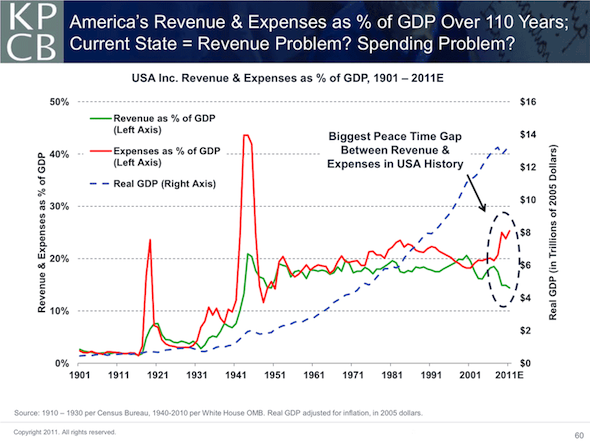
However, the last part of the presentation is dedicated to USA Inc., a look at the US federal government as if it were a business. As Meeker states in the intro of the original USA Inc. report:

Imagine for a moment that the United States government is a public corporation. Imagine that its management structure, fiscal performance, and budget are all up for review. Now imagine that you’re a shareholder in USA Inc. How do you feel about your investment? Mary Meeker USA Inc. Report, Feb. 2011

Well, looking at slide 60, If I were an American citizen, I would not feel good at all.

America's Revenue and Expenses as % of GDP in the last 110 years

How to fix this issue? Depending on the solutions, we will have very different social and economic situations.

And, probably, a new U.S. president.

Google Plus… Plus What?

Google has announced its earnings for Q3 2011. Impressive numbers, as always: two-digit percentage growth almost everywhere, and a pile of more than 45$B in cash. Everything comes off of search revenue.
The same good ol’ story.

Everyone was expecting a few more insights on the Android business and on the Googlerola affair. Nope. Not a single word.

However, they did confirm that Google+ has over 40 million users. And a lot of surprises still to show. Larry Page has outlined the significant effect he foresees Google+ will have on the company’s business.

Our ultimate ambition is to transform the overall Google experience — making it beautifully simple, almost automagical, because we understand what you want and can deliver it instantly.

This means baking identity and sharing into all of our products so that we build a real relationship with our users. Sharing on the web will be like sharing in real life across all your stuff. You’ll have better, more relevant search results and ads. [ed.: see a previous post on the possible implications of Google’s +1]

Of course, now comes the hard part: developing Google+ in a manner that leads it to attain a critical mass of users and makes it a real contender to Facebook.

On this side, IMHO, success is far from certain:

  1. Google+ Has 40 Million Users, But How Many Use It?
  2. Google+ will never beat Zuckerberg on his own turf. There are plenty of reasons, all well summarized in this article on Gizmodo
  3. Data analytics company Chitika recently published results of a study that revealed that Google+ traffic has deflated, following a spike after the social networking service came out of a limited beta on Sept. 20, and fallen back to the usage level it had before becoming publicly available
  4. It also looks like there are some Googlers not sharing the optimism of their CEO. A couple of days ago, a Google engineer named Steve Yegge mistakenly published publicly a post in which he leveled some sharp criticism at Google+, calling it “a knee-jerk reaction, a study in short-term thinking” in large part because it lacks a strong developer platform.
  5. Until now, the approach of Google to social networks has been, to say the least, controversial. Orkut is used in Brazil only (but Facebook is growing at a light-speed pace), and they have just decided to shut down Buzz.

So, how is Google going to conquer the world with Google+? Is the Big G really going to put Google+ at the center of its existence and rebuild its other products around it? It’s sounds radical, but that’s precisely what Google seems to be willing to do. Page said

We shipped the ‘Plus’, and now we’re going to ship the Google part.

Recommendations are key tools in marketing, and +1 and Google Plus could really become the automated version of word of mouth that is supposed to sit atop search engines. Nonetheless, it’s a gamble to build your core business on a social network that’s a few months old and only has 40 million users. But it will be fascinating to see Google strive to make Google+ the formidable pivot of the ecosystem that Page envisions.

Meanwhile, sit down and relax: we still have to see what the outcomes of Facebook’s “curated search” patent will be…