Leaderless World

The G-Zero World

I agree on every single word:

We live in a crisis-prone age. In the past 44 months, we’ve endured the dips and gyrations of an international financial crisis, the worst economic slowdown since the 1930s, a wave of turmoil across North Africa and the Middle East, and Europe’s worst crisis of confidence since the Second World War. Unfortunately, we can’t expect smoother sailing in years to come because, for the first time in seven decades, we now live in a world without global leadership.

[…]

So we’ve entered a period of transition. The old order, call it a U.S.-led G7 world, no longer reflects the true international balance of power. But there is not yet a new order to take its place. That’s why global markets are in for an extended (and tumultuous) period of transition, one that’s especially vulnerable to crises that appear suddenly and from unexpected directions. It’s a G-Zero world.

(mon emphase) — Ian Bremmer on the Harvard Business Review Blog

The new mayor? A Computer.

Your Next Mayor? A Computer.

Our planet is becoming smarter, and this isn’t just a metaphor.

Three years ago, 100 Parisians volunteered to wear a wristband with a sensor in it. The sensors measured air and noise pollution as the wearers made their way around the city, transmitting that data back to an online platform that created a virtual map of the city’s pollution levels, which anyone with an Internet connection could take a look at.

This was a peek at an urban future when “smart cities” will collect data of all kinds (in all kinds of ways) and use it to make themselves better places to live. With the market projected to be worth $16 billion by the end of the decade, big companies like IBM and Cisco have much grander — and more profitable — ambitions: they’re going all-in on smart cities, with designs that supposedly do everything from end traffic jams to prevent disease outbreaks to eliminate litter.

As IBM Chairman Samuel J. Palmisano said at the 2010 SmarterCities forum in Shanghai:

Computational power is being put into things we wouldn’t recognize as computers. Indeed, almost anything—any person, any object, any process or any service, for any organization, large or small—can become digitally aware and networked.

Think about the prospect of a trillion connected and instrumented things—cars, appliances, cameras, roadways, pipelines… even pharmaceuticals and livestock.

And then think about the amount of information produced by the interaction of all those things. It will be unprecedented.

The Ties That Bind

Researchers from Tel Aviv University, in collaboration with the Kiel Institute of World Economy in Germany, have developed a new methodology that measures the interconnections between stock markets across the globe.

It has the potential to serve as an early warning system and provide measures to manage and mitigate the spread of financial crisis.

There’s nothing new in analyzing the correlations between stocks in an individual market, using parameters such as market index and volatility to determine whether prices of stocks will rise or fall in tandem. But with this project, the researchers have introduced the concept of the meta-correlation, in which they measure the average correlation of countries’ stock markets against one another. The result is a precise understanding of how changes in one market impact another. At worst, these connections can lead to a fast spread of financial crisis.

To develop their method, the researchers looked at data from six major world markets — the U.S., the U.K., Germany, Japan, China, and India — from the beginning of 2000 to the end of 2010. Choosing the leading stocks in each market, the team then mapped the correlations between the groups of stocks from each country over the 11-year period. With the exception of China, which tended to operate independently, the researchers discovered an interesting pattern of interdependencies between these markets. Some markets, such as the U.K. and U.S., were closely connected, as predicted. But there were also surprising findings, such the fact that Japan fluctuates in its financial alignment between western and eastern countries.

A Financial Seismograph

According to the researchers, this method of understanding market connections could help each country predict when a financial crisis is imminent, allowing it to set up policies that will protect their own markets from becoming dangerously intertwined with struggling markets. As Prof. Ben-Jacob of TAU’s School of Physics and Astronomy says:

In the current era, when the global financial village is highly prone to systematic collapses, our approach can provide a sensitive ‘financial seismograph’ to detect early signs of global crisis.

Citing Greece’s financial problems and their impact on the European market as a whole, Ben-Jacob’s Ph.D. student Dror Kenett continues:

There are different safety mechanisms that each country can implement. Germany is so invested in Greece that they don’t have an option other than to bail Greece out

noting that if it had been able to see the extent of their dangerous connection with Greece, Germany could have opted to reduce its investments earlier.

John Maynard Keynes

Sovereign Wealth = Sovereign Power? (2/2)

Second and final part of a short essay I wrote in 2009 (but still relevant in many aspects). Here you can find the first part and all the details.

A new world order (continued)

The rise of emerging economies (China, India and Russia on all) emphasizes the fact that in a growing proportion of the world economy, the state governance plays a fundamental role in allocating resources for international investment. In the last twenty years, the political leaders of Western countries have followed the dictates of Ronald Reagan and Margaret Thatcher, trying to subtract as much as possible the influence of the government from economic life. Markets should be working (only) on three key principles: Privatisation, Liberalisation and Deregulation. However, the problems faced by the financial markets since the end of 2006 following the outbreak of the subprime mortgage bubble, have brought black clouds on the “market-only approach” to modern capitalism. After the near collapse of the U.S. and EZ banking system and the serious problems posed by the world credit crunch, on the horizon is looming the return to state governance crucially more involved in international economic and financial affairs.

In other words, we are finally beginning to understand that the dichotomy that opposes the “more government, less market” to “more market, less government” is false, and that the historic changes set in motion by globalization and technological revolution require much more complex response of the old-fashioned statism or of a liberism preaching the “laissez-faire capitalism”. Probably, the answer can be found in the scheme “more government, more market”, meaning for “more government” not necessarily a stronger presence of public money, but certainly a stronger ability to determine policies, indicating the strategic guidelines to move the productive forces, and for “more market” a set of simple rules that should ensure the greatest possible transparency to the dynamics of profit.

Somebody may wonder if that could mean a return to a Keynesian economic system. In my humble opinion, the theory of John Maynard Keynes cannot be proposed “as is”. Instead, if returning to Keynesianism means the rediscovery of the need to definitively overcome the dichotomy liberalism – statism, and recovering the role of public policies in the market, then it is useful and appropriate to return to speak of the man who is rightly considered the father of modern macroeconomics. With his theories, Keynes argued the need for regulatory intervention by the state, primarily by using the instruments of monetary policy and credit. His thinking is certainly useful when reasoning about the future of globalization: there is no doubt, in fact, that we have entered a sort of “phase two” of the process of integration of global economies and markets, and this season should not be characterized from a return to protectionism, but from the definition of common rules and new world organizations that go beyond technical ones, such as IMF and World Bank, and political ones, such as various G7-G20 .

Here is a very convincing statement of Dani Rodrik of Harvard University [click for reference]

The first three decades after 1945 were governed by the Bretton Woods consensus — a shallow multilateralism that permitted policymakers to focus on domestic social and employment needs while enabling global trade to recover and flourish. This regime was superseded in the 1980s and 1990s by an agenda of deeper liberalisation and economic integration. That model, we have learned, is unsustainable. If globalisation is to survive, it will need a new intellectual consensus to underpin it. The world economy desperately awaits its new Keynes.

new-day-dawn

Sovereign Wealth = Sovereign Power? (1/2)

In 2009 I wrote some papers for the department of social sciences at the University of Florence. Among these, the main study was on the Sovereign Wealth Funds “phenomenon”. The field I was approaching was History of International Economic Relations. Rereading my work, I realized that I still think the same about the possible answers to the questions posed by the (supposed?) new world order. Here’s what.

A new world order

Towards the end of the nineteenth century, the borders of Britain’s financial empire went well beyond politics. The dependence of a country from English economic power was ahead, more or less formally, to the submission to political power. When the Egyptian Khedive had the need to raise cash to cover his personal debt in respect of some British private banks, he could do nothing but sell its shareholding in the Suez Canal Company. The Khedive certainly did not act better when it came to managing the Egyptian public debt: the difficulty in honouring it brought England and France to take control of the Egyptian Treasury, and finally, in 1882, Egypt was put under military occupation. [click for reference]

In 1956, the decision of Egyptian President Gamal Abdel Nasser to nationalize the Suez Canal Company (owned by an Anglo-French coalition) provided to UK and France a justification for organizing a joint military operation against Egypt, which led to the occupation of the Channel from England (along with France and Israel, with the latter having joined the conflict on the side of the European powers). The financial status of the UK, however, was no longer that of the previous century: Britain had indeed a small current account surplus, but in 1956-57 the pound sterling had become subject to speculative pressures. The Bank of England made extensive use of its dollar reserves to support the exchange rate existing between the pound and the dollar, but came to a point where the threat of a forced devaluation or a change to a flexible exchange rate system was real. The United States, then the largest single creditor of Great Britain, declared that their intention to continue to provide direct financial support to England and to participate in an IMF loan for the United Kingdom, would depend to the compliance by British government with a UN General Assembly resolution calling on the United Kingdom, France and Israel to withdraw from the Suez Canal. [click for reference]

The American ultimatum forced Britain to reconsider its position. Anthony Eden, then British prime minister, explained that:

We were therefore faced with the alternatives, a run on sterling and the loss of gold and dollar reserves till they fell well below the safety margin […] or make the best we could of UN takeover and salvage what we could. [click for reference]

The lesson which follows from the the Suez crisis should be, especially for the United States, rather obvious: political strength is (almost always) related to financial strength. For example, the capabilities of a debtor country to carry out military actions depend largely on the support provided by creditor countries. Militarily, the United States are stronger today than it was Great Britain in the ’50s and are also not obliged to keep the dollar exchange rate to a predetermined level. However, in other respects, US financial position is more precarious than English one at the time of the Suez crisis. Indeed, while in 1956 the English had even a small current account surplus, the United States, at the end of 2010, had a current account deficit of about $ 120 billion, i.e. -3.2% of their GDP. Furthermore, Britain’s main creditors were British political and military allies (the United States on all) while, on the other side, U.S. debt, is not funded by “allies”: without investments in U.S. government securities made by China, Russia and the Gulf countries, the dollar would suffer a substantial depreciation, boosting U.S. interest rates. This would be difficult to sustain for the United States, because it would put entirely on the shoulders of the domestic economy the cost of maintaining their international role.

After all, it seems that the U.S. have the ability to borrow huge amounts of money at very favourable rates. Their dependence on foreign financing could be considered not as vulnerability, but as a sign of strength on the international scene: simply, the American economy could be too big to fail.

Actually, one could suggest the opposite, namely that the growing U.S. current account deficit represents a strategic (read: political) understated vulnerability. The willingness of central banks in emerging countries to accumulate dollar reserves has provided a stable source of debt financing. The problem is that these central banks already hold far more reserves than they need, so that they can also be used to finance new investment vehicles (Sovereign Wealth Funds, in fact). True, central banks still have an interest in maintaining the dollar relatively strong, but the U.S. may have more to lose than to gain from a possible “showdown” with the monetary authorities in creditor countries. In a nutshell: the more the U.S. will continue to base their economy on deficit financed by the investment vehicles in emerging countries (central banks and sovereign wealth funds), the more they will reduce their strength on the international stage.

In addition to that, it can be observed that the economic weight of China, India, Russia, Brazil, Arab States of the Gulf and other emerging economies will increase in the twenty-first century. Also if China’s growth were to grow at a slower pace than the current, it is likely that China, over the next twenty-five years, will displace the U.S. as the largest economy in the world. [click for reference]

This step alone would involve substantial changes to the world economy and to institutions which are responsible for the global governance. At the moment, however, the increase in the relative economic importance of these new actors is accompanied by another dramatic change: the emerging economies have become creditors of the industrialized countries.

This flow of state capital appears more and more as the consequence of political choices rather than the natural evolution of the global economy. Indeed, the size of Chinese population suggests that China should be the first economy in the world and not the largest creditor of the West! Moreover, the weight of the U.S. foreign debt, concentrated in a limited number of counterparties – many of which do not share the Western democratic values – undeniably represents a strategic vulnerability. This certainly does not mean that these creditors will improperly use their “bargaining power”, but the United States should act to avoid the possibility that a foreign country, for example, could suddenly reduce its dollar investments as a response to a foreign policy dispute. Given the magnitude of the american debt position, this could cause a shock to the U.S. economy no less severe than that following the subprime credit crisis. (… here is the second part)


old-new-thermo-feat

U.I.O. – Uniquely Identifiable Objects

Over the next 10 years, the physical world will become ever more overlaid with devices for sending and receiving information […] With the continuing exponential increase in the power of the planetary computer, one has to wonder whether we stand at the beginning of what Isaac Asimov’s “Foundation” series, more than 60 years ago, called “psychohistory.” His visionary genius Hari Seldon believed that statistical forecasting of human society’s actions would be possible with data from enough people throughout the galaxy.
In the next several decades, we will have a glimpse of whether something similar can emerge on planet Earth.

Larry Smarr: An Evolution Toward a Programmable Universe

Business Insider predicts that in 2012 we will see a lot of hype around The Internet Of Things. True or not, as a matter of fact, the also called Industrial Internet is already here. Across many industries, products and practices are being transformed by communicating sensors and computing intelligence. Low-cost sensors, clever software and advancing computer firepower are opening the door to new uses in energy conservation, transportation, health care and food distribution. The role of sensors — once costly and clunky, now inexpensive and tiny — was described this month in the NYT in the essay quoted at the beginning of this post (Larry Smarr is the founding director of the California Institute for Telecommunications and Information Technology).

Technology Roadmap The Internet of Things

Technology Roadmap: The Internet of Things (source: Wikipedia)

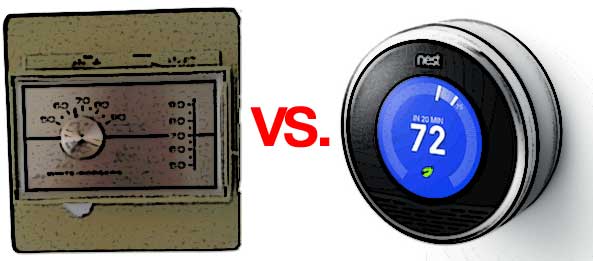
That may sound like blue-sky futurism, but evidence shows that the vision is beginning to be realized on the ground, in recent investments, products and services, coming from large industrial and technology corporations and some ambitious start-ups. One of the hot new ventures in Silicon Valley is Nest Labs, founded by Tony Fadell, a former Apple executive, which has hired more than 100 engineers from Apple, Google, Microsoft and other high-tech companies. Its product, introduced in late October, is a digital thermostat, combining sensors, machine learning and Web technology. It senses not just air temperature, but the movements of people in a house, their comings and goings, and adjusts room temperatures accordingly to save energy.

From this perspective, the consumer Internet (the one we are already accustomed to) can be seen as the warm-up act for these technologies. Think about software techniques like pattern recognition and machine learning used in Internet searches, online advertising and smartphone apps that are also ingredients in making smart devices to manage energy consumption, health care and traffic. Take Google’s driverless car, for example.

The automated cars, each with a human along for the ride, have deftly navigated thousands of miles on California highways and city streets. The project — a research effort so far — uses a bundle of artificial intelligence technologies, as does Google’s Search and AdWords/AdSense business.

In such a smart world, the real dilemma will rather be finding the right trade-off between society’s efficiency, innovation and (guess what?) control. We can only hope that politicians will be capable of dealing with such problems.